
When Rocklin’s lunch bell rings at 1:45 p.m., many students don’t have time to decompress. They’re figuring out how quickly they can eat, find friends, and get to class on time. Both students and teachers say the 30-minute lunch period leaves little room to do it all. “It’s a rush,” said Michael Wagner, a health teacher at Rocklin High School.
Students say that short lunch periods feel more stressful than relaxing, leaving them tired by the time they return to class. Research suggests that limited breaks during the day can affect students’ learning and well-being. According to Dr. Murray, former chairman of the American Academy of Pediatrics’ Council on School Health, “The science shows pretty clearly that taking … breaks [during] the day makes students better able to encode memory and learn and perform academically. There’s a lot on the table in terms of the child’s health, [well-being] and academic success.”
Shorter lunch periods also leave students with little time to move around or relax. Freshman Michaela Morales said, “It’s like at least a five-minute wait. And then usually people eat [for] … five to ten minutes. That’s already half of your lunchtime …. And then … if you want to do anything else, that’s only 15 minutes left.” She added that by the time she gets to lunch, she’s often “hangry” and stressed before heading back to class.
Two years ago, Rocklin High School used a schedule called Plus Period, which allowed students who were passing all of their classes to go to lunch earlier. The schedule gave those students between 50 and 55 minutes for lunch. Wagner explained that “the duration of flex and lunch [was] over an hour long.” He added that students who did not need to attend Plus Period “could go out to an early lunch and combine that with [the] regular lunch period,” giving them significantly more time than students have now.
While students and teachers describe feeling rushed, administrators say the shorter lunch period helps maintain structure and safety on campus. Michael Pappas, the principal of Rocklin High School, said that over the past two years the school has implemented FLEX and connected it to break, which he said is “a better spot in the day for that time … that learning time [and] intervention time.”
Even though students still feel rushed, Principal Pappas explained that the shorter lunch has made it easier for staff to supervise and maintain campus safety. He added that “the number of students leaving campus and other disciplinary issues has decreased,” further improving supervision and reducing incidents. However, students continue to say that the schedule increases stress throughout the day.
Even some of the older students say lunch doesn’t provide enough time to eat and get help from teachers. Junior Zachary Schanmeier said that “I think it gives you less time to relax between classes and … if you need to do anything or talk to people, meet people, I think that would suck.”
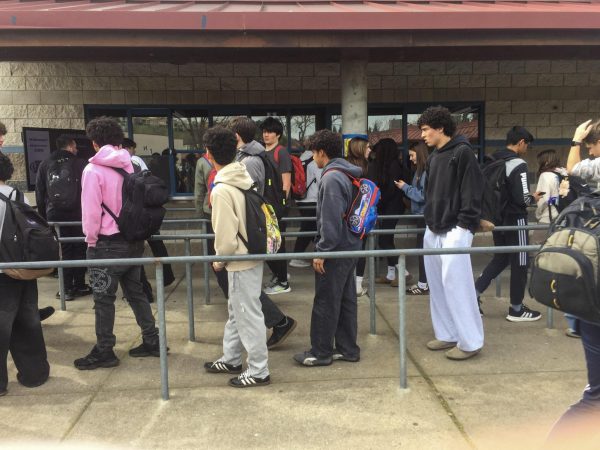
Students say that having enough time during the school day to take breaks and get things done is essential and could improve productivity while allowing them to breathe. Several students said that even on a good day it takes two minutes to get through the lunch line, while on busier days the wait is closer to three to five minutes.
The school must also meet state-mandated instructional minutes, which limits how long lunch can be. Pappas explained, “We do have a total number of minutes that we have to fulfill as a school each year … in a two-week span, we have a certain number of minutes that we have … [for] instructional time.”
According to the University of Washington Food Systems, Nutrition, and Health program, one out of seven children in the U.S. is food insecure and uncertain where their next meal will come from. Children who experience food insecurity are at a higher risk for chronic disease, poor mental health, lower academic performance, and unhealthy behaviors in adulthood.
“So often we’re cutting lunch period time for the academics, but in fact, … when students don’t have a sufficient amount of food, we often see an increase in disruptive behaviors in the classroom and poorer focus,” said Juliana Cohen, a professor of nutrition at Merrimack College and the Harvard School of Public Health. “We need to provide sufficient nutrition for them to come back to the classroom able to focus and to learn.”
Two years ago, students who qualified for Plus Period had nearly an hour to eat and recharge, showing that longer lunches are possible under certain circumstances. As the school weighs these competing priorities, students, teachers, and administrators alike are reminded that even small adjustments to the schedule can have a big impact on learning, health, and campus life.